Hiring Strategies for Growing Companies in 2026
Updated: Sep 22

As businesses grow, attracting and hiring the right people gets harder, not easier. HR teams have to fill roles quickly, manage larger applicant pools, and maintain a positive candidate experience, all while keeping recruitment efficient. That pressure isn't easing up: 66% of U.S. hiring managers plan to increase permanent hiring in the second half of 2026, while 58% say finding qualified talent is harder than it was twelve months ago.
Ref: Robert Half, 2026 Hiring Plans
Strong hiring strategies help organizations:
meet the gap between rising demand and shrinking talent supply,
combine AI recruitment, AI hiring, and recruitment automation to streamline workflows
improve decision-making.
This guide covers the most effective hiring strategies for growing companies, the practices that drive successful recruitment, and how platforms like HiringGenie help HR teams attract top talent while scaling efficiently. The goal isn't just filling roles faster. It's building a hiring process that gets stronger, not more fragile, every time the company adds headcount.
Why Hiring Strategies Matter More as You Grow
Business growth creates new hiring opportunities, but it also brings real recruitment challenges. As teams expand, recruiters need to attract qualified candidates faster, manage larger talent pipelines, and keep applicants engaged throughout the process. Manual recruitment tends to slow this down, which is exactly where a deliberate recruitment approach starts to matter more than raw recruiter headcount.
The pain is measurable and getting worse, not better. 43% of U.S. hiring managers say it's taking longer to fill open positions than it did two years ago, and 44% report having jobs they simply cannot fill, the highest level since fall 2023
Ref: Express Employment Professionals / Harris Poll, 2026
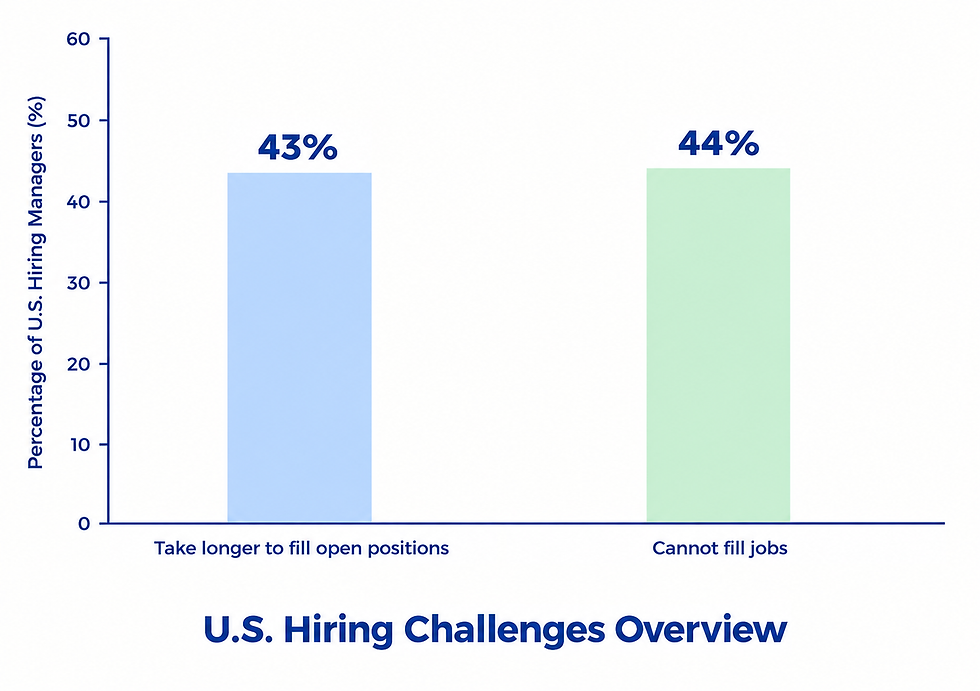
Ref: Express Employment Professionals, Harris Poll, 2026
Companies that treat hiring strategies as a one-time setup rather than an evolving system tend to hit the same bottlenecks again every time headcount jumps, usually right when the business can least afford the slowdown.
Common Hiring Bottlenecks as Companies Scale
As businesses expand, recruitment gets more demanding: filling multiple roles at once, processing a growing number of applications, and moving candidates through the process without slowing the business down. The scale of that shift is stark. Applications per job rose from 146 in 2022 to 746 in 2025, a 412% increase, while the number of recruiters per organization fell 56% over the same period
Ref: Greenhouse, The Hire Standard 2026 Benchmark Report

Ref: Greenhouse, The Hire Standard 2026 Benchmark Report
Fewer recruiters are being asked to handle dramatically more applications, and that mismatch is where most high-volume hiring problems actually start. To close that gap, many organizations invest in AI recruitment, AI hiring, and recruitment automation.
These tools reduce manual work, organize recruitment workflows, and support better decisions, helping recruiters manage high volume hiring without losing consistency or quality.
The alternative, adding recruiter headcount at the same pace applications are growing, simply isn't realistic for most growing companies, which makes the technology less of an optional upgrade and more of a structural necessity. If your team is struggling to keep pace with rising applications, take a look at how HiringGenie can be beneficial to you.

Building a Repeatable Hiring Process with AI Recruitment
A strong recruitment strategy depends on a clear, repeatable process that scales as the business grows, and modern recruiting technology is increasingly what makes that repeatability realistic rather than aspirational.
Step 1: Define the Hiring Requirements
Start by identifying the responsibilities, required skills, experience level, and qualifications for the role. Clear requirements are the foundation of any effective hiring strategy, and skipping this step is one of the most common reasons later stages fall apart.
Step 2: Source and Attract Candidates
Use multiple channels, job boards, referrals, career pages, and AI-powered sourcing tools, to reach a wider talent pool and improve candidate quality from the very first stage of the funnel.
Step 3: Screen Applications Efficiently
Review resumes using structured criteria or AI-powered screening tools to quickly identify qualified applicants. This step delivers some of the clearest measurable payoff: 89% of HR professionals whose companies use AI in recruiting report time savings or increased efficiency (Ref: SHRM, 2025 Talent Trends).
Step 4: Conduct Structured Interviews
Evaluate candidates with consistent questions and standardized assessment methods. A structured process creates a fairer experience for every applicant and makes comparing candidates far easier once several are in play at once.
Step 5: Assess and Select Candidates
Review interview feedback, technical skills, and cultural fit before deciding. Automated workflows can organize candidate information and simplify collaboration between hiring teams spread across departments or locations.
Step 6: Measure and Improve the Process
Track metrics like time-to-hire, quality of hire, and candidate feedback to refine your hiring strategies over time. Continuous improvement helps organizations manage high volume hiring more efficiently as they grow, rather than re-learning the same lessons every hiring cycle.
Together, these six steps create a scalable process that holds up whether a company is hiring five people this quarter or fifty this year.

Balancing Speed and Candidate Experience While Growing
Hiring quickly should never come at the cost of quality. Strong hiring strategies combine efficient recruitment with a candidate experience people genuinely value.
Clear communication
Keeping candidates informed throughout the process builds trust and creates a more professional experience.
Smarter sourcing
AI-powered sourcing automates repetitive tasks, freeing recruiters to spend time building relationships with top talent.
Structured screening
AI-powered screening tools help standardize evaluation, improving consistency while letting hiring teams make informed decisions faster.
Automated scheduling
Automating interview scheduling, candidate communication, and reduces manual effort and keeps the process organized as volume climbs.
The companies that manage to hire fast without sacrificing experience tend to share one trait: they've automated the repetitive parts of the process so recruiters can spend their time on the parts that actually require judgment, not the reverse.
How AI Recruitment and Recruitment Automation Strengthen Your Hiring Strategies
As hiring demand grows, the right technology helps teams recruit more efficiently without replacing human judgment. The strongest recruiting approaches combine recruiter expertise with AI-powered tools, technology as an amplifier, not a substitute, for good recruiting instincts.
Better tooling is what's letting fewer recruiters keep pace with far more applicants, not headcount growth. The growth payoff extends beyond the recruiting function itself. Small businesses that adopted AI grew headcount 7% faster than comparable peers in their first year after adoption, and companies with fewer than 10 employees grew teams about 10% faster than non-AI users
Ref: Gusto Insights, 2026
Small Businesses | 2022 | 2025 | Overall Change |
Applications Per Job | 146 | 746 | +412% |
Recruiters Per Organization | 100 | 44 | -56 |
Ref: Gusto Insights, 2026
For a growing company, that's not a minor efficiency gain, it's a measurable difference in how fast the business itself can scale.
When choosing recruiting technology, look for automation that integrates cleanly into your existing process rather than forcing a rebuild of workflows that already work. If you're also evaluating the cost side of that decision, see how to choose the right subscription plan for AI hiring software before committing to a platform.
Hiring Strategies Checklist for 2026
As recruitment gets more competitive, growing businesses should regularly check whether their hiring strategies are actually built for what's next, rather than assuming last year's approach still holds up.
Have you planned your hiring strategies in advance?
Effective hiring strategies start with workforce planning and goals that align with company growth plans, not reactive hiring triggered only once a role is already overdue.
Are you making the most of AI-powered recruiting tools?
The right tools simplify sourcing and resume screening, freeing recruiters to focus on engaging, qualified talent rather than digging through resumes one by one.
Have you automated your hiring workflow?
Automating scheduling, candidate communication, and admin work reduces delays and improves efficiency across every open role, not just the highest-priority ones.
Can your recruitment process grow with your business?
Scalable, AI-powered tools make it easier to manage high volume hiring while maintaining quality as you expand into new teams, regions, or business lines.
How HiringGenie Supports Growing Teams
As businesses expand, recruitment needs to evolve with them. HiringGenie gives growing organizations the tools to strengthen recruitment, helping HR teams recruit efficiently while keeping the process feeling strong for applicants from application through hire, not just at the top of the funnel.
By bringing AI-powered sourcing, AI-driven screening, and workflow automation together in one platform, HiringGenie simplifies day-to-day recruiting. Recruiters can organize candidate pipelines, automate repetitive workflows, and track progress without juggling multiple systems, all without letting candidate experience slip as volume increases.

Whether you're filling a handful of roles or managing high volume hiring, HiringGenie adapts as your needs grow, cutting admin work and supporting faster, more confident decisions while keeping recruiters fully in control of every step that requires human judgment.
Ready to strengthen your hiring strategy? Explore how HiringGenie's automated interview software helps growing companies streamline recruitment and find the plan that fits your organization.
Conclusion
As businesses keep expanding, effective hiring strategies are essential for attracting top talent and building recruitment that actually scales. Combining smarter sourcing, AI-powered screening, and workflow automation helps organizations improve efficiency, support high volume hiring, and strengthen the candidate experience at every stage.
The data backs up what most growing companies already suspect from experience: application volume keeps climbing, recruiter capacity isn't climbing with it, and the gap between the two is exactly where hiring strategies either hold up or quietly fall apart. The companies that treat their hiring strategies as a living system, not a one-time policy, are consistently the ones still hiring well a year from now.
Frequently Asked Questions
What are hiring strategies?
Structured approaches businesses use to attract, assess, and hire qualified candidates, combining recruitment planning, technology, and best practices to improve efficiency while supporting long-term growth.
How can AI recruitment improve hiring?
AI recruitment tools automate tasks like candidate sourcing, resume screening, and interview scheduling, freeing recruiters to spend more time engaging qualified candidates and improving the overall candidate experience.
What is hiring workflow automation?
Technology that simplifies repetitive hiring activities such as interview coordination, candidate communication, and workflow management, reducing admin work and improving efficiency.
Can artificial intelligence replace recruiters entirely?
No. AI hiring tools are built to support recruiters by improving consistency, reducing manual tasks, and surfacing better insights. Final hiring decisions stay with HR teams and hiring managers.
How can growing companies manage high volume hiring?
By combining scalable recruitment processes, structured evaluation, and solid hiring strategies with the right technology to maintain quality as the company expands.


Comments