What Are AI Scorecards in Recruitment?
Updated: Sep 23

Finding the right candidates quickly and consistently has become a major challenge for modern recruiters. As application volumes rise, HR teams need to evaluate candidates fairly, reduce hiring delays, and make confident decisions without piling on more manual effort. AI Scorecards solve this by providing standardized candidate evaluation, objective AI scoring, and data-driven hiring insights throughout the recruitment process.
Why AI Scorecards Are Replacing Gutfeel Hiring Decisions
Traditional hiring often relies on interview notes, subjective opinions, and inconsistent feedback, making it hard for recruiters to compare candidates fairly. AI Scorecards fix this by pairing structured interviews with standardized scoring, letting HR teams evaluate applicants consistently and screen candidates at scale.

Ref: SHRM 2025 Talent Trends
Adoption backs this up: AI use in HR tasks jumped to 43% in 2025, up from 26% in 2024, with recruiting the leading use case at roughly 51% of organizations. As more teams invest in AI-powered recruitment, AI Scorecards are quickly becoming a standard part of modern hiring rather than an experimental add-on.
Ref: SHRM 2025 Talent Trends
What Is an AI Scorecard?
An AI scorecard is a structured evaluation framework that uses artificial intelligence to help recruiters assess and compare candidates consistently throughout the hiring process. Instead of relying solely on interview notes or personal opinions, it lets HR teams measure candidates against predefined criteria, making the process more objective and efficient.
Structured, not just digital notes.
Same criteria for every candidate.
Enables fair and consistent Candidate evaluations.
Improves hiring decisions.
Replaces spreadsheets with standardized assessments.
How AI Scorecards Are Generated from Structured Interviews
Define the criteria
Recruiters start by defining the skills, competencies, and job requirements candidates will be assessed against, building a scorecard with standardized criteria so every applicant is measured on the same framework.
Run structured interviews
Candidates complete a live or asynchronous interview through the platform, and every applicant gets the same set of questions, so recruiters collect genuinely comparable responses. If you're still choosing a format, our guide on choosing the right video interview platform covers what to look for.

Capture responses
As candidates complete the interview, the platform securely records video, audio, or written responses, creating a centralized record that supports accurate evaluation later.
AI scoring analyzes the data
The platform scores responses against predefined criteria, assessing communication, role-specific competencies, and other measurable signals to support more consistent decisions.
The scorecard is generated
Once the interview wraps up, the system automatically builds a scorecard summarizing candidate performance, highlighting strengths and gaps, and organizing results into a standardized format with an overall score, a competency breakdown, and relevant transcript excerpts recruiters can reference without rewatching the full interview.
Recruiters compare and shortlist
Recruiters review AI-generated scorecards alongside resumes, interview feedback, and other hiring data, pairing structured evaluation with centralized screening to compare applicants fairly and spot the strongest candidates faster.
This kind of automation has a measurable time payoff: talent acquisition professionals using generative AI tools report saving roughly 20% of their work week, close to a full day.
Ref: LinkedIn Future of Recruiting 2025 Report
What an AI Scorecard Measures
Communication skills
How clearly a candidate explains their experience, ideas, and answers, a core input for consistent assessment across every applicant
Role-specific competencies
Using predefined criteria, the platform measures the technical skills and knowledge a role actually requires, making candidates easier to compare fairly
Problem-solving and critical thinking
During live interviews, candidates are evaluated on how they analyze situations, work through problems, and justify their reasoning, scored against consistent standards
Job and culture fit
Scorecards can capture how well a candidate's behaviors and values align with the role and the organization, giving recruiters another data point alongside the rest of their hiring criteria
Overall candidate performance
Interview responses, competency scores, and recruiter feedback come together in a single scorecard, making the whole screening process easier to review at a glance
Consistency Across Interview Rounds
When multiple people interview the same candidate at different stages, scores can drift depending on who's evaluating and when. A well-designed scorecard keeps the same criteria applied at every round, so a candidate's second interview is judged on the same terms as their first and scorecards can surface patterns across a candidate's full application journey, not just a single conversation.
AI Scorecards vs. Traditional Interview Notes
Category | AI Scorecards | Traditional Interview Notes |
Evaluation Method | Standardized scoring using predefined criteria | Personal notes and subjective observations |
Consistency | Every candidate assessed against the same criteria | Standards vary between interviewers |
Candidate Comparison | Easy side-by-side comparison | Manual comparison across scattered notes |
Scalability | Built for high-volume screening | Time-consuming at scale |
Recruiter Workload | Scoring automated and centralized | High manual effort for notetaking and comparison |
Structured interviews are what make this comparison possible in the first place without a consistent question set to score against, even the best AI scorecard has little to work with.
Benefits of AI Scoring for Fairer Hiring Decisions
The right evaluation framework helps organizations make faster, fairer, more consistent hiring decisions. AI scoring gives recruiters standardized criteria, making it easier to compare applicants while cutting down on subjectivity.
The impact shows up in real outcomes. Organizations reaching AI-mature recruiting performance have realized up to 119% higher recruiter productivity, 57% faster time-to-fill, and 61% lower recruiting cost per hire.
Ref: The Hackett Group AI World Class HR Benchmarks, 2026
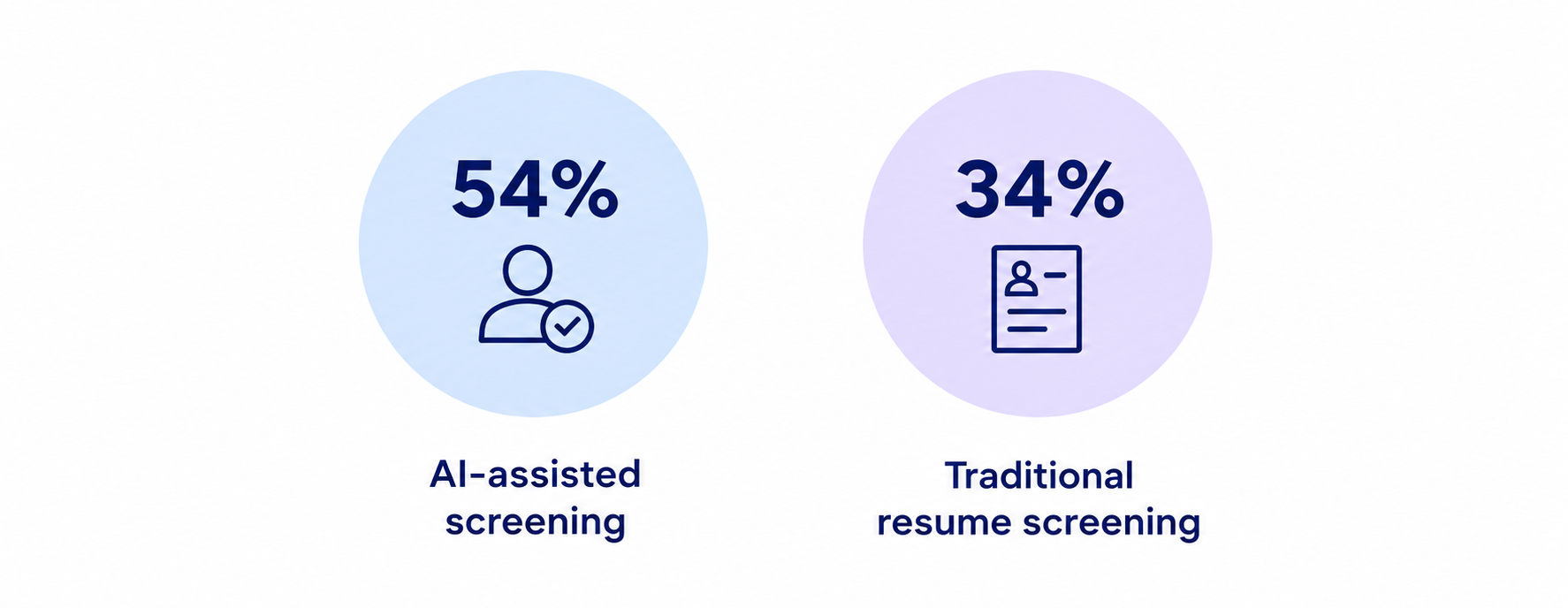
And it's not just efficiency: in a randomized field experiment with roughly 37,000 junior-developer applicants, candidates advanced through an AI-assisted structured screen passed a later human interview at 54%, versus 34% for traditional resume screening a 20-point improvement in downstream interview success
Ref: Quantifying the Benefits of AI-Assisted Recruitment," 2025
There's also a benefit that's easy to underestimate: a searchable, structured record of every past hire. Over time, that history lets a hiring team see what strong scorecards actually had in common, turning individual decisions into a pattern the whole team can learn from.
Quality of hire is where this shows up most concretely. 61% of talent acquisition professionals believe AI can improve how quality of hire is measured, and organizations using AI-assisted evaluation most intensively are 9% more likely to make a quality hire. Skills-based assessment the same principle behind role-specific scorecard criteria is also a rising priority across recruiting teams' industry-wide.
Ref: LinkedIn Future of Recruiting 2025 Report
How Recruiters Use AI Scorecards for Fairer AI Candidate Screening
Once interviews wrap up, recruiters often need to compare several strong candidates for the same role. Scorecards simplify this by organizing results into a standardized format, making it easy to review strengths, competencies, and interview performance side by side.
Using AI hiring software, recruiters apply consistent criteria across every applicant instead of relying on handwritten notes or memory. The efficiency case is well-supported: 89% of HR professionals whose organizations use AI for recruiting say it saves time or increases efficiency Ref: SHRM 2025 Talent Trends
For a closer look at how automation fits earlier in the funnel, see our guide on AI automated candidate screening vs. manual screening.

Centralized scorecards also improve collaboration between recruiters and hiring managers. Instead of digging through scattered feedback, decision makers can access interview summaries, scores, and competency assessments in one place, reducing bias and improving transparency across the screening process.
How HiringGenie's AI Hiring Software Powers Scorecards
HiringGenie is built to simplify evaluation by combining scorecards with AI-powered recruitment workflows. Rather than replacing recruiters, it helps HR teams assess applicants more consistently while keeping the process standardized across every role.
Metric | Value |
AI resume & candidate scoring adoption | 44% |
Teams planning further AI rollout | 48% |
Improved candidate satisfaction | ~60% |
Improved recruiter satisfaction | ~37% |
Faster hiring process | ~34% |
AI scoring streamlines candidate evaluation by combining structured scorecards, interview analysis, and centralized comparisons in one platform. The industry data above shows increasing adoption and measurable improvements in hiring efficiency and user satisfaction.
Ref: IC2 AI Maturity Survey / Brief for TA Leaders, 2025–2026
Core capabilities at a glance
Structured scoring criteria by role, centralized dashboards for comparing candidates, and shareable scorecards hiring managers can review without sitting in on every interview.
Ready to see it in action? Explore how HiringGenie pairs AI Scorecards with automated interview software, check out HiringGenie pricing page to find the plan that fits your organization, or visit our homepage for the full picture of how AI hiring works end-to-end.

Common Mistakes When Adopting Scorecard-Based Hiring
Copying a generic template instead of building role-specific criteria
A scorecard built for a sales role and reused for an engineering role will miss what actually matters for each; the most effective scorecards are tuned to the specific competencies a role requires, not a one-size-fits-all checklist.
Treating the score as the final answer
A scorecard is a strong input, not a verdict. Teams that skip human review entirely, hiring or rejecting based purely on a number, tend to miss context a score alone can't capture, like a candidate's potential to grow into a role.
Never revisiting the criteria
Roles change, teams grow, and what a company needs from a hire shift over time. A scorecard built two years ago for a very different team size or strategy can quietly become outdated if nobody revisits it.
Rolling out without training hiring managers
Even the best scorecard is only as useful as the people reading it. Teams that skip a short onboarding on how to interpret scores often end up ignoring the tool altogether within a few months.
Avoiding these missteps is usually less about the technology and more about treating scorecard-based hiring as an evolving part of the process, not a one-time setup task.
Conclusion
As recruitment keeps evolving, AI Scorecards have become an important tool for organizations that want more consistent, fairer candidate evaluation throughout the hiring process. From objective AI scoring to standardized criteria, they help HR teams make faster, better-informed decisions without replacing human judgment.
Choosing the right hiring platform can improve recruitment efficiency, strengthen collaboration, and simplify screening. Platforms like HiringGenie pair AI Scorecards with fair candidate evaluation to help recruiters hire with more confidence.
Frequently Asked Questions
What are AI scorecards?
Structured evaluation tools that help recruiters assess candidates using predefined criteria, organizing interview feedback, competency assessments, and AI scoring into a consistent format for easier comparison.
How do AI scorecards work?
They collect interview data from structured interviews and organize it into a standardized framework, letting recruiters compare candidates, review competencies, and support more objective decisions.
Do AI scorecards replace recruiters?
No. They organize candidate evaluation and improve consistency, but recruiters and hiring managers stay responsible for reviewing candidates and making the final hiring decision.
Can AI scoring actually improve hiring decisions
Yes. Paired with a consistent interview format, AI scoring reduces subjectivity, improves consistency, and supports fair AI candidate screening, making it easier to identify qualified candidates.
What should I look for in AI hiring software?
Look for customizable scorecards, standardized evaluation criteria, secure candidate management, integration with your existing interview process, and reporting that helps HR teams make faster, data-driven decisions.
Can scorecards be customized for different roles?
Yes. The strongest scorecards let you define different criteria for different roles, since what matters for a sales hire looks very different from what matters for an engineering hire.
How long does it take to see value from AI Scorecards?
Most teams see faster shortlisting and more consistent comparisons within the first few hiring cycles, since AI Scorecards get most of their value from having a standardized record for every candidate rather than needing months of historical data to build up.


Comments