How to Choose the Right Subscription Plan for AI Hiring Software
Updated: Sep 23

The race for top talent is faster and fiercer than ever, and AI hiring software is giving hiring teams a real edge, taking the guesswork out of candidate selection and putting routine admin on autopilot. Yet for HR strategists, the real challenge often starts before the contract is even signed: how do you actually choose the right subscription plan for the future of your hiring? That single decision shapes budget, workflow, and hiring capacity for the next year or more.
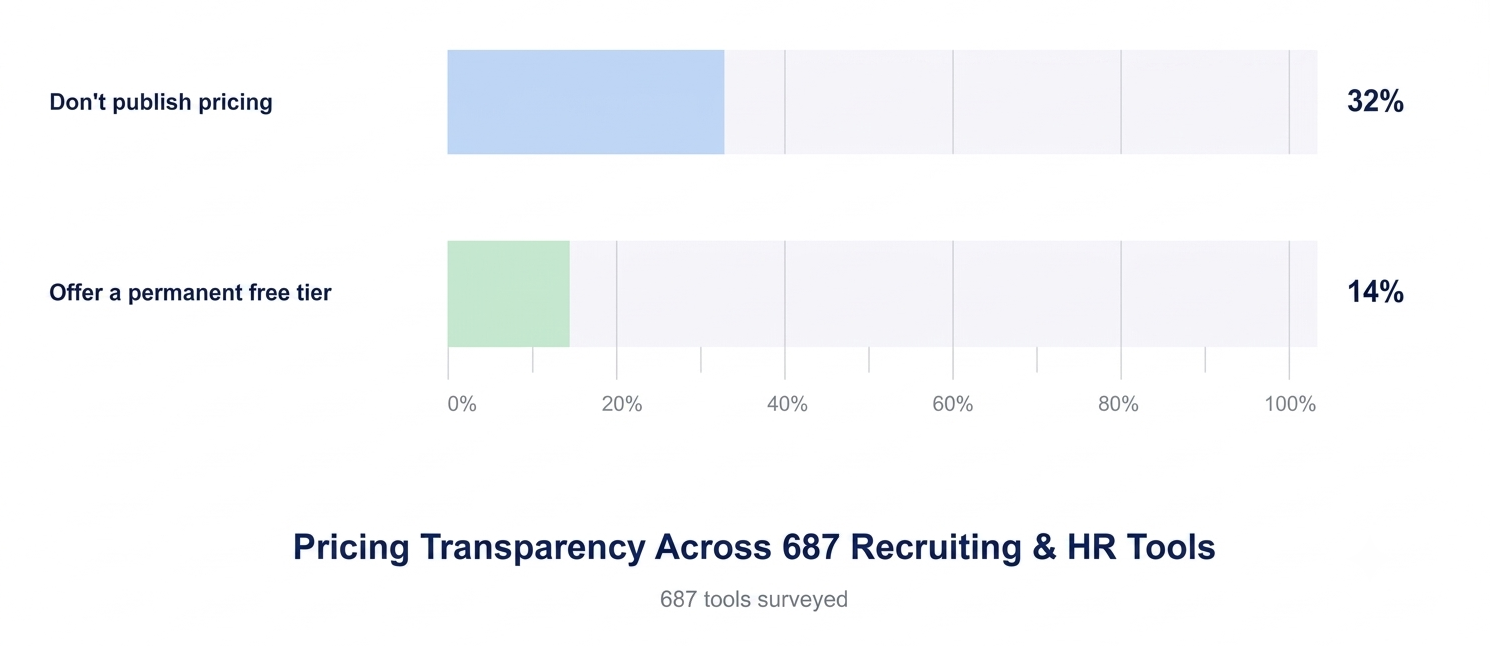
Comparison is harder than it should be from the start. Across 687 recruiting and HR tools surveyed, 32% don't publish pricing at all, and only 14% offer a permanent free tier. When a third of the market hides its pricing, buyers are often left comparing sales calls instead of numbers, this guide is built to give you the numbers first.
Ref: Work Insiders, Recruiting Software Pricing Statistics 2026
Why AI Hiring Software Pricing Isn't Just About Cost
AI has genuinely transformed talent acquisition. Candidate sourcing, resume screening, and automated scheduling are all faster than they were a few years ago. But as HR leaders modernize their hiring stack, they run into a surprisingly complex hurdle before signing anything: figuring out the right subscription plan for AI interview software.
Choosing the right subscription plan is about more than finding the lowest price. It's about finding the option that delivers real value for your organization's actual needs. Understanding your hiring volume, team size, budget, and long-term goals is what lets you invest in a subscription plan that improves how your team screens and evaluates candidates, and delivers real ROI, not just the most features for the money.
For a broader look at how automation fits into this decision, see Hiring Genie's guide to Automated Interview Software: Benefits, Features & How It Works

AI Hiring Software Pricing Guide: What the Market Actually Charges
This pricing guide starts with a market baseline, so you can judge whether a quoted number is fair before you're deep in a sales conversation. Among tools that publish a monthly price, the median starting point is $49/month, and more than half of tools start under $50/month, with three-quarters under $100/month. Pricing varies meaningfully by category: interviewing tools median around $74/month, applicant tracking systems around $79/month, and assessment tools around $87/month.
Ref: Work Insiders, Recruiting Software Pricing Statistics 2026
Named starting prices tell a similar story at the lower end of the market: Manatal starts around $15/user/month, Zoho Recruit around $25/user/month, flat-rate tools run $49–$100/month for unlimited users, and higher-end platforms like Workable ($169–$299/month) or LinkedIn Recruiter Lite ($170/month per seat) sit well above that. Pricing models generally split into per-seat, per-job, per-candidate or credit-based, and custom enterprise contracts, and the sticker price is rarely the final cost.
Ref: Hire Truffle, AI Recruiting Software Pricing Guide 2026
AI Capability Level and Cost
Capability Level | Common Features | Pricing |
Basic AI | Resume parsing, job description generation, basic candidate matching | Lower |
Advanced AI | AI avatar interviewing, automated technical evaluations, competency scoring | Higher |
Common Pricing Models for an AI Recruitment Platform
Model | Description | Trade-off |
Subscription-based | Fixed monthly or annual fee for platform access | Predictable, but can be costly if underused |
Pay-per-use | Charged only for resumes processed or candidates assessed | Good for seasonal hiring, unpredictable monthly cost |
Freemium / add-on | Free basic tier, advanced features behind a paywall | Low risk to test, but limited functionality free |
At the higher end, annual AI recruiting contracts range from roughly $5,000 to $500,000 a year, with a median around $70,667 among tools that publish pricing, while flat monthly pricing ranges from $0 to $719, with a median near $342. Enterprise-grade video and AI interview platforms often start around $25,000 to $50,000 or more per year.
Ref: Cost Bench, AI Recruiting Software Pricing 2026
An AI recruitment platform priced around basic automation looks far cheaper on paper than one built for deep, competency-based evaluation, but the cheaper option often costs more in recruiter hours down the line.
Match Your Subscription Plan to Company Size
Company size is one of the clearest predictors of what a fair subscription plan actually costs. Organizations with 50 to 200 employees typically budget $1,000 to $30,000 a year for AI recruiting tools; companies with 200 to 1,000 employees' budget $8,000 to $90,000; and organizations above 1,000 employees typically spend $50,000 to $250,000 or more annually. First-year implementation can add another 20% to 100% on top of the subscription cost for larger buyers.
Ref: Sprad, AI Recruiting Software Pricing 2026
Small to mid-sized teams (low volume, high focus)
Often juggle recruiting, payroll, and employee relations simultaneously, and manual admin eats into strategic time fast. Useful capabilities here:
Automated candidate sourcing across multiple platforms
Resume screening to quickly shortlist qualified candidates
Interview scheduling that removes calendar back-and-forth
High-volume and enterprise teams (scale, speed, intelligence)
Manage large pipelines, multi-region compliance, and complex internal approval chains, where the real bottlenecks are pipeline congestion and inconsistent standards across departments. Useful capabilities here:
Sourcing tuned to identify candidates likely to succeed in a specific role
Large-scale candidate matching and ranking against job requirements
Interview intelligence: AI-generated summaries for more consistent decisions
Hiring analytics and reporting to track recruitment performance
Choose a subscription plan that fits current needs with room to grow. Starting with essential capabilities and expanding as demand increases tends to maximize value better than over-buying upfront.
Hidden Costs to Watch for in Your Subscription Plan
The initial quote on a subscription plan rarely reflects your actual total cost of ownership, and that gap can be substantial: implementation alone can add 20% to 100% on top of the base subscription for larger organizations. Vendors are often upfront about the headline price and far less upfront about everything layered on top of it:
Ref: Sprad, AI Recruiting Software Pricing 2026
Costs That Can Raise Your Total Spend
Implementation, tuning, and training
Vendors frequently charge for workflow setup and fine-tuning matching models on your historical data.
Enterprise security and compliance
Role-based permissions, bias audit reporting, and data privacy tools are often locked behind top-tier packages.
Integration fees
Connecting to your existing HR tech often means a one-time connector setup fee or requires a higher Enterprise tier just to unlock it.
Autorenewals
Multi-year contracts may include automatic price increases and strict opt-out windows, making fine-print review as important as comparing prices.
How to Evaluate ROI on Your Subscription Plan Before Committing
Evaluating ROI on a subscription plan requires a clear line between spend and measurable impact, since "it saves time" rarely clears a finance team's bar on its own. The numbers back up that a well-chosen plan can clear that bar decisively.
Organizations using AI in recruiting commonly report 20–40% lower cost-per-hire against a U.S. average of $4,700–$5,475 for non-executive roles, alongside time-to-hire reductions of 25–50%. Some analyses put average ROI at 340% within 18 months of implementation, and 89% of HR professionals whose companies use AI in recruiting report measurable time savings or efficiency gains.
Ref: SHRM Benchmarking Report 2025
Key Factors to Consider When Evaluating Hiring Software ROI
Factor in implementation, training, integration, and premium feature costs to understand the total cost of ownership.
Convert recruiter hours saved on sourcing and screening into actual labor-cost savings.
Track time-to-hire, shortlisting speed, and roles filled within target timelines to measure efficiency gains.
Compare current hiring spend with agency fees, advertising costs, and HR overtime to estimate potential savings.
Assess whether the software can handle increasing hiring volume without requiring costly upgrades.
Before committing to any subscription plan long-term, request a trial or pilot and measure results against your current process. The best subscription plan isn't necessarily the cheapest, it's the one delivering the most value for how your team actually screens, evaluates, and hires.
HiringGenie's Subscription Plans and Recruitment Automation, Explained
HiringGenie simplifies early-stage candidate screening through AI avatar interviews and recruitment automation, cutting repetitive screening calls and standardizing the interview experience without sacrificing quality, even at high applicant volume. Every subscription plan below reflects a different point on that scale, and against the market medians above ($342/month flat-rate, $70,667/year among annual contracts), HiringGenie's tiers sit well within reach of small and mid-sized teams rather than at the enterprise end of the range.
You can also see how this fits into a broader evaluation process on our AI interviews page.
Trial: Free, no credit card required.
Starter: $399/month
Growth: $599/month
Enterprise: Custom pricing.
Enterprise leans hardest on recruitment automation of any tier, since enterprise teams carry the most repetitive workflow to offload, from multi-region compliance checks to high-volume interview scheduling.
Which Subscription Plan Should You Choose?
Plan | Best For |
Trial | Exploring AI-powered interviewing before committing |
Starter | Small businesses, occasional hiring |
Growth | Growing teams, higher recruitment volume |
Enterprise | Large orgs, high-volume hiring, advanced security |
Explore HiringGenie's homepage or check out the full pricing page to find the subscription plan that fits.
Conclusion
Finding the right subscription plan isn't about buying the most feature-packed software on the market. It's about choosing the model that fits your hiring speed, team size, and volume fluctuations, and being honest about which of those three actually matters most for your team right now. AI can genuinely improve talent acquisition, but only if the pricing model behind it actually matches your real hiring needs. A well-chosen plan streamlines hiring, improves decision-making, and reduces recruitment costs over time, a strategic choice here pays off well beyond the contract itself.
If you're still comparing how automation affects day-to-day screening, our guide on AI automated candidate screening vs. manual screening is a useful next read.

Frequently Asked Questions
What exactly is a subscription plan for AI hiring tools?
A pricing plan giving ongoing access to AI-powered recruitment tools for a monthly or annual fee. Features vary by tier, from candidate sourcing and resume screening to analytics and integrations.
Which HiringGenie subscription plan offers the best value?
It depends on hiring volume, team size, and goals. Trial suits testing the platform, Starter fits smaller teams, Growth supports expanding recruitment, and Enterprise scales for large organizations with advanced needs.
Can organizations upgrade their subscription plan as hiring needs grow?
Yes. You can start smaller and upgrade as demand increases, getting the features you need today while adding capacity and support later.
How can I calculate the ROI of this platform?
Compare total subscription cost against the benefits of reduced time-to-hire, lower recruitment costs, improved recruiter productivity, and reduced turnover, the market data above suggests these gains are often substantial enough to justify a higher tier.
Are AI hiring software plans scalable?
Most providers offer multiple tiers so you can start with essential features and add advanced capabilities as demand grows.
When should an organization consider upgrading to a higher tier?
When recruitment activity is climbing, hiring teams are growing, or you need to manage multiple open roles at once, a higher tier typically adds interview volume, collaboration features, and priority support.
Are there hidden costs with this kind of subscription plan?
Some providers charge extra for implementation, onboarding, training, premium integrations, additional users, or advanced analytics. Reviewing the pricing structure line by line before signing helps avoid surprises once you're already locked into a contract term.
Should I choose a monthly or annual option
Monthly offers flexibility, useful for evaluating a platform or handling changing needs without a long-term commitment. Annual plans usually cost less overall and suit teams with consistent, long-term hiring needs rather than seasonal spikes.


Comments